Glossary Terms:
Focus on Economic Data: U.S. Real GDP Growth, January 30, 2013
Glossary terms from:
http://www.econedlink.org/e1145
Alternative
One of many choices or courses of action that might be taken in a given situation.
Bank
A financial institution that provides various products and services to its customers, including checking and savings accounts, loans and currency exchange.
Budget
A spending-and-savings plan, based on estimated income and expenses for an individual or an organization, covering a specific time period.
Business
Any activity or organization that produces or exchanges goods or services for a profit.
Business Cycles
Fluctuations in the overall rate of national economic activity with alternating periods of expansion and contraction; these vary in duration and degrees of severity; usually measured by real gross domestic product (GDP).
Capacity
In the context of credit transactions, capacity is one of the Three Cs of Credit. It is an indicator of how creditworthy a prospective borrower is likely to be, as determined by the borrower's current and future earnings relative to current debt. High earnings and low debt, for example, indicate a strong capacity to make payments on the loan in question.
Capital
Resources and goods made and used to produce other goods and services. Examples include buildings, machinery, tools and equipment. In the context of credit transactions, capital is one of the Three Cs of Credit. It is an indicator of how creditworthy a prospective borrower is likely to be as determined by the borrower's current financial assets and net worth.
Consumers
People who use goods and services to satisfy their personal needs and not for resale or in the production of other goods and services.
Consumption
Spending by households on goods and services. The process of buying and using goods and services.
Costs
An amount that must be paid or spent to buy or obtain something. The effort, loss or sacrifice necessary to achieve or obtain something.
Demand
The quantity of a good or service that buyers are willing and able to buy at all possible prices during a period of time.
Distribution
The allocation or dividing up of the goods and services a society produces.
Durable Goods
Goods intended to last for a period of more than three years.
Economic Growth
An increase in real output as measured by real GDP or per capita real GDP.
Economics
The study of how people, firms and societies choose to allocate scarce resources with alternative uses.
Exports
Goods and services produced in one nation and sold in other nations.
Firms
Economic units that demand productive resources from households and supply goods and services to households and government agencies.
Full Employment
The natural rate of employment; generally considered to be about 93-95 percent of the labor force, allowing for frictional unemployment of 5-7 percent.
Goods
Tangible objects that satisfy economic wants.
Government Expenditures
Goods and services provided by government and paid for by taxing and borrowing. Federal government expenditures include national defense and a system of justice. State and local government expenditures include police, roads and public education.
Government Spending
Spending by all levels of government on goods and services; includes categories like military, schools and roads.
Gross Domestic Product (GDP)
The market value of all final goods and services produced in a country in a calendar year.
Households
Individuals and family units that buy goods and services (as consumers) and sell or rent productive resources (as resource owners).
Imports
Goods and services bought from sellers in another nation.
Income
Payments earned by households for selling or renting their productive resources. May include salaries, wages, interest and dividends.
Inflation
A rise in the general or average price level of all the goods and services produced in an economy. Can be caused by pressure from the demand side of the market (demand-pull inflation) or pressure from the supply side of the market (cost-push inflation).
Interest
Money paid regularly, at a particular rate, for the use of borrowed money.
Inventory
An itemized list of goods held by a person or business. Also a quantity of goods held in stock.
Investment
The purchase of capital goods (including machinery, technology or new buildings) that are used to produce goods and services. In personal finance, the amount of money invested in stocks, bonds, mutual funds and other investment instruments.
Labor
The quantity and quality of human effort available to produce goods and services.
Lagging Indicators
Economic variables such as the prime interest rate, labor cost per unit of output, inventories to sales ratio and unemployment duration that tend to change after real output changes.
Markets
Places, institutions or technological arrangements where or by means of which goods or services are exchanged. Also, the set of all sale and purchase transactions that affect the price of some good or service.
Natural Resources
"Gifts of nature" that can be used to produce goods and services; for example, oceans, air, mineral deposits, virgin forests and actual fields of land. When investments are made to improve fields of land or other natural resources, those resources become, in part, capital resources. Also known as land.
Net Exports
Exports minus imports.
Poverty
The state of being poor, variously defined. Sometimes defined relatively--by reference, for example, to the average household income in a nation or region. Sometimes defined absolutely--by reference, for example, to the income needed to provide for adequate food, housing and clothing in a nation or region.
Price
The amount of money that people pay when they buy a good or service; the amount they receive when they sell a good or service.
Price Level
The weighted average of the prices of all goods and services in an economy; used to calculate inflation.
Producers
People and firms that use resources to make goods and services.
Product
A good or service that can be used to satisfy a want.
Production
A process of manufacturing, growing, designing, or otherwise using productive resources to create goods or services used to to satisfy a want.
Production Possibilities Frontier
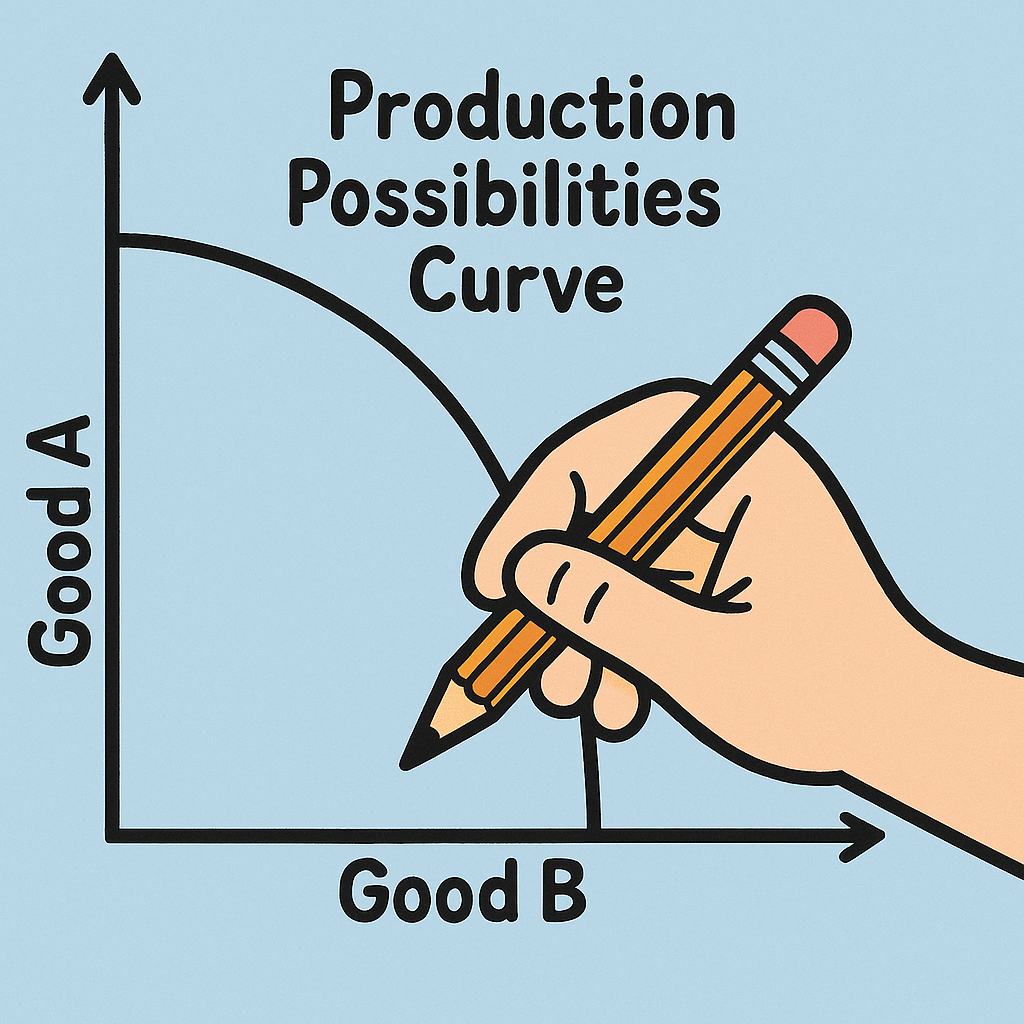
A table or graph that shows the full employment capacity of an economy in the form of possible combinations of two goods, or two bundles of goods, that could be produced with a given amount of productive resources and level of technology.
Productive Resources
Natural resources, human resources, capital resources and entrepreneurship used to make goods and services.
Productivity
The amount of output (goods and services) produced per unit of input (productive resources) used.
Purchases
In a credit arrangement, the total amount spent during the billing cycle.
Recession
A decline in the rate of national economic activity, usually measured by a decline in real GDP for at least two consecutive quarters (i.e., six months).
Recessionary Gap
The amount by which the aggregate expenditures curve must increase (shift upward) to increase the real GDP to the full-employment noninflationary level.
Resources
The basic kinds of resources used to produce goods and services: land or natural resources, human resources (including labor and entrepreneurship), and capital.
Revenue
The money a business receives from customers who buy its goods and services. Not to be confused with profit.
Sale
An exchange of goods or services for money.
Services
Activities performed by people, firms or government agencies to satisfy economic wants.
Standard of Living
The level of subsistence of a nation, social class or individual with reference to the adequacy of necessities and comforts of daily life.
Stock
An ownership share or shares of ownership in a corporation.
Supply
The amount of a good or service that producers are willing and able to offer for sale at each possible price during a given period of time.
Trade
The exchange of goods and services for money or other goods and services.
Unemployment
The number of people without jobs who are actively seeking work.
Unemployment Rate
The number of unemployed people, expressed as a percentage of the labor force.
Work
Effort applied to achieve a purpose or result, often for pay; skills and knowledge put to use to get something done; employment at a job or in a position; occupation, profession, business, trade, craft, etc.
Workers
People employed to do work, producing goods and services.